
Continuing the series on Bell’s theorem, I will now write about its most popular version, the one that people have in mind when they talk about quantum nonlocality: the version that Bell proved in his 1975 paper The theory of local beables.
But first things first: why do we even need another version of the theorem? Is there anything wrong with the simple version? The problem is that it is rather misleading.
Quantum mechanics clearly respects no conspiracy and no action at a distance, but clearly does not respect determinism, so the most natural interpretation of the theorem is that trying to make quantum mechanics deterministic is a bad idea. Which is true, but is not the whole story: one might think that giving up determinism is enough to retain locality. It’s not. It’s enough to retain no action at a distance, but you still need to sacrifice a precious notion of locality in order to violate Bell inequalities: local causality.
Informally, it says that causes are close to their effects. A bit more formally, it says that probabilities of events in a spacetime region $A$ depend only on stuff in its past light cone $\Lambda$, and not on stuff in a space-like separated region $B$. So we have
- Local causality: $p(A|\Lambda,B) = p(A|\Lambda)$.
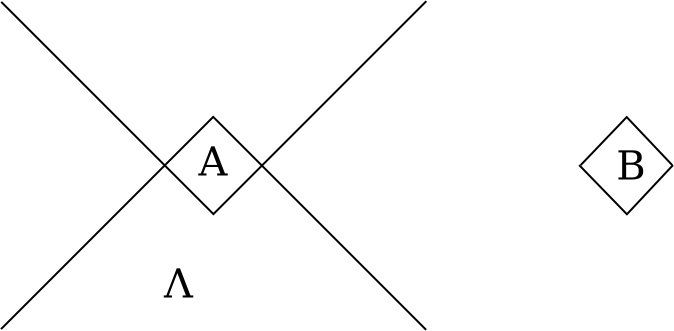
How do we derive a Bell inequality from that? Start with the identity
\[p(ab|xy\lambda) = p(a|bxy\lambda)p(b|xy\lambda)\]and consider Alice’s probability $p(a|bxy\lambda)$: obtaining an outcome $a$ certainly counts as an event in $A$, and Alice’s setting $x$ and the physical state $\lambda$ certainly count as stuff in $\Lambda$. On the other hand, $b$ and $y$ are clearly stuff in $B$. So we have
\[ p(a|bxy\lambda) = p(a|x\lambda) \]Doing the analogous reasoning for Bob we have
\[ p(b|xy\lambda) = p(b|y\lambda) \]and substituting this back we get
\[p(ab|xy\lambda) = p(a|x\lambda)p(b|y\lambda).\]This equivalence is called factorizability, and is all that we need. If we recall the decomposition of the probabilities we get from no conspiracy
\[ p(ab|xy) = \sum_\lambda p(\lambda)p(ab|xy\lambda) \] and join it with factorizability, we end up with
\[ p(ab|xy) = \sum_\lambda p(\lambda)p(a|x\lambda)p(b|y\lambda) \]Noting that for any coefficients $M^{ab}_{xy}$ the Bell expression
\[ p_\text{succ} = \sum_{abxy} \sum_\lambda M^{ab}_{xy} p(\lambda)p(a|x\lambda)p(b|y\lambda) \]is upperbounded by deterministic probability distributions $p(a|x\lambda)$ and $p(b|y\lambda)$, the rest of the proof of the simple version of Bell’s theorem applies, and we’re done.
So there we have it, a perfectly fine derivation of Bell’s theorem, using only two simple and well-motivated assumptions: no conspiracy and local causality.
It annoys me to no end that people very often use factorizability as an assumption instead of local causality. Why would you go for some dry technical assumption instead of one with a clear physical meaning? Is it just a desperate move to avoid admitting that there is something nonlocal about quantum mechanics? Or maybe is there a good way to motivate factorizability? I don’t think so.
It was first postulated by Clauser and Horne in 1974. Their justification is that factorizability
…is a natural expression of a field-theoretical point of view, which in turn is an extrapolation from the common-sense view that there is no action at a distance.
What are they talking about? Certainly not about quantum fields, which do not factorize. Maybe about classical fields? But only those without correlations, because otherwise they don’t factorise either! Or are they thinking about deterministic fields? But then they could postulate determinism directly! And anyway why do they claim that it is an extrapolation of no action at a distance? They don’t have a derivation to be able to claim such a thing!
Nowadays people don’t use Clauser and Horne’s motivation for factorizability, though, but instead Reichenbach’s principle, which states that if two events A and B are correlated, then either A influences B, B influences A, or there is a common cause C such that
\[ p(AB|C) = p(A|C)p(B|C)\]
It is easy to see that this directly implies factorizability for the Bell scenario.
It is often said that Reichenbach’s principle embodies the idea that correlations cry out for explanations. This is bollocks. It demands the explanation to have a very specific form, namely the factorised one. Why? Why doesn’t an entangled state, for example, count as a valid explanation? If you ask an experimentalist that just did a Bell test, I don’t think she (more precisely Marissa Giustina) will tell you that the correlations came out of nowhere. I bet she will tell you that the correlations are there because she spent years in a cold, damp, dusty basement without phone reception working on the source and the detectors to produce them. Furthermore, the idea that “if the probabilities factorise, you have found the explanation for the correlation” does not actually work.
I think the correct way to deal with Bell correlations is not to throw your hands in the air and claim that they cannot be explained, but to develop a quantum Reichenbach principle to tell which correlations have a quantum explanation and which not. This is currently a hot research topic.
But leaving those grandiose claims aside, is there a good motivation for Reichenbach’s principle? I don’t think so. Reichenbach himself motivated his principle from considerations about entropy and the arrow of time, which simply do not apply to a simple quantum state of two qubits. There may be another motivation other than his original one, but I don’t know of any.
Therefore, as far as I know local causality is really the only way to motivate factorisability. So please do not conflate them or, even worse, claim that they are equivalent. They’re not.
To conclude, should we consider them the nonlocal version of Bell’s theorem as the ultimate version, and forget about the simple version? We can’t, because it doesn’t allow you to do quantum key distribution based on Bell’s theorem.1 If you use the simple version of Bell’s theorem and believe in no action at a distance, a violation of a Bell inequality implies not only that your outcomes are correlated with Bob’s, but also that they are in principle unpredictable, so you managed to share a secret key with him, which you can use for example for a one-time pad2
Update: Rewrote the paragraph about QKD.